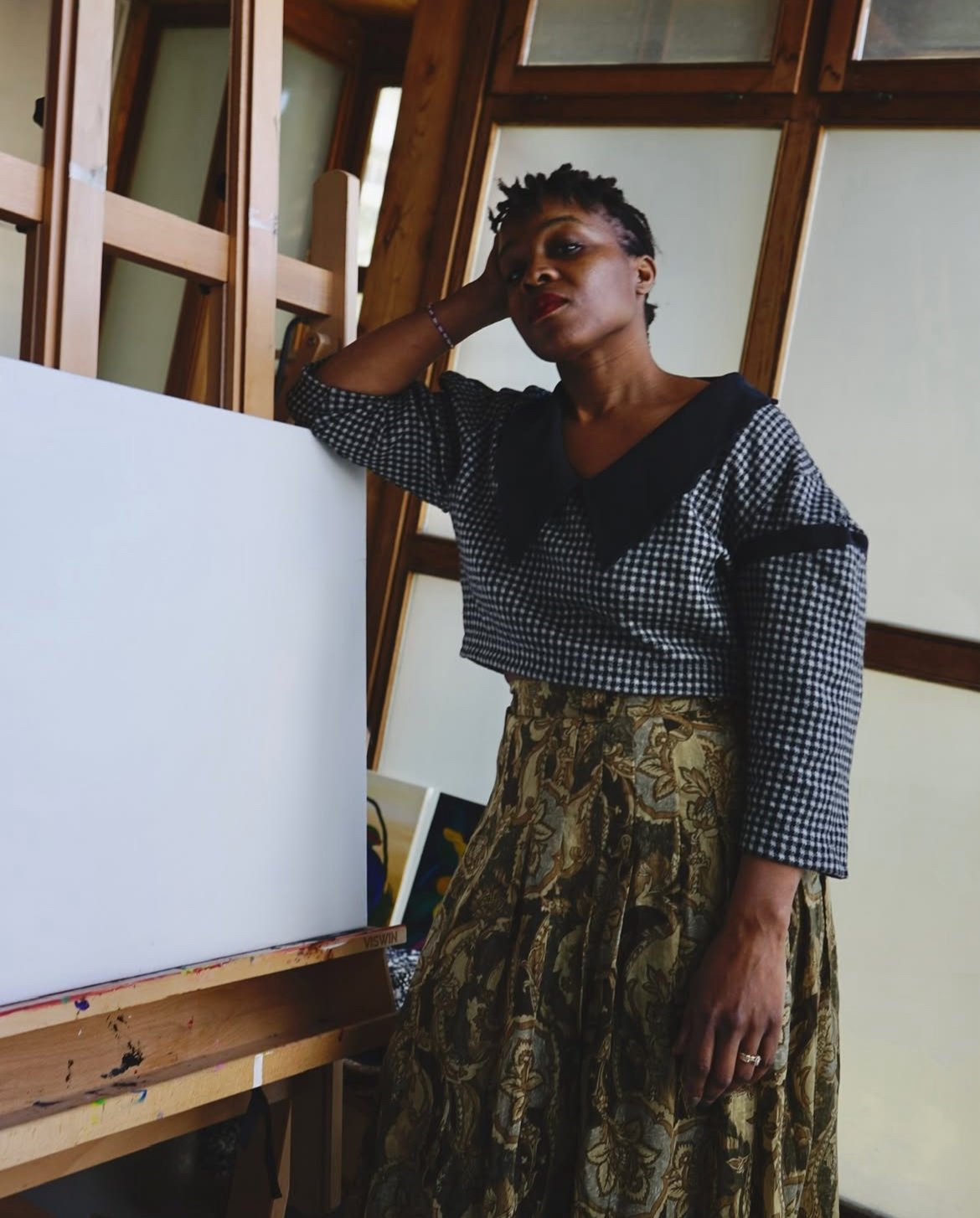
Nathalie Christophe Dao is a French painter of Haitian descent based in Paris. After studying philosophy, she attended the École des Beaux-Arts in Rueil-Malmaison before pursuing training in visual merchandising, which led her to work for the House of Chanel. She subsequently brought her own vision to life through the creation of Rosamen Bado, a sustainable fashion brand. Today, she develops a figurative painting practice focused on the construction of the image and the presence of the figure.
Her work primarily centres on portraits of women. The figures, both hieratic and frontal, inhabit an autonomous pictorial space. They are engaged in neither action nor narrative; instead, they remain self-contained, suspended in a timeless state. Their presence asserts itself through posture and a direct relationship with the viewer's gaze.
Colour occupies a central place in her practice. It is employed as a structural element of the image, in close dialogue with both the figure and the painted surface. The palettes are bold and deliberate, contributing to the density, cohesion, and visual strength of the work as a whole.
The flower is a recurring motif in her paintings. It is not treated as an ornament; rather, it functions as a plastic force that traverses, frames, or partially conceals the figure. Its presence introduces a tension between an appearance of fragility and a capacity for endurance. Through its cycle and repetition, the flower inscribes the image within a temporality that extends beyond that of the human body.
Her work engages in dialogue with the tradition of portraiture, particularly that of the Renaissance, through the frontality of the figures, the stability of the image, and the attention paid to bodily presence. This approach is rooted in a contemporary visual culture shaped by our relationship to images, clothing, and surface.
The relationship to fashion runs through her practice without defining it. Fabrics and materials drawn from the world of dress are used as supports or incorporated directly into the paintings. They operate as fully-fledged plastic elements, activating the surface of the image and influencing the ways in which the body is framed and presented.